A Discussion on Ecumenical Councils and the Papacy
The following is a debate between myself and others about the nature of the condemnation of Pope Honorius by a successor Pope, Leo II during the Sixth Ecumenical Council (Constantinople III, 681 AD). This implications of this debate are essential for understanding the Catholic view of the doctrine of Papal infallibility and the rejection of the heresy of conciliarism (the belief that an Ecumenical Council’s authority is over that of the Pope’s). For clarity, Erick Ybarra has at no time claimed to be a conciliarist. It will become clear from the discussions, which took place on X on several occasions in 2024, that it is not my intention to defend any wrongdoing of Pope Honorius or deny the anathema against him.
Exchange between JT (myself) and Erick Ybarra in response to the following post from Dr. Edward Feser:
Feser: No intellectually honest person can deny that Pope Francis is comparable to the notorious Pope Honorius, who was condemned by his successors and by three councils for giving aid and comfort to heresy. The difference is that Honorius’s errors were fewer and less obvious.
JT: Except that Warren Carrol observed an Ecumenical Council is not such until ratified by the reigning Pontiff, in this case, Leo II, who condemned Honorius for negligence and not heresy. Meanwhile Agatho, John IV, Maximus the Confessor, and Bellarmine all defend his orthodoxy.
Ybarra: No, sir. Pope St. Leo II did not defend the orthodoxy of Honorius. He showed no protest to the judgment of the Council, and further accused the Pope of treachery and staining the doctrinal purity of the Apostolic See. Oh, and he said that while Honorius did this, it was also an act of negligence on his part since he, as the Pastor of all churches, was commissioned to defend the Church rather than attempt to thwart her beliefs.
(the assertion here by Ybarra that Pope Leo II showed “no protest to the judgment of the Council” is demonstrably incorrect by the fact that the words of Pope Leo II’s condemnation and those of the Council are not in agreement).
JT: Respectfully sir, I did not claim that Leo II explicitly defended the orthodoxy of Honorius, but that he did not verbatim affirm the accusations made at the Council. And there seems to be a clear reason for this. His protest is clear in changing the words of the condemnation.
Ybarra: But he didn’t change anything. Anyone who seeks to make a change legally, per Roman law or any civil law theory for that matter, prefaces what they are changing. Here is simply says Honorius, in addition to other evils, was negligent. You are the one reading into his words
JT: What is your general view of a Pope teaching heresy? Apparently you believe it is possible. But then what, a Council can judge the Pope? That is conciliarism. And how do you explain Agatho’s letter which claims his predecessors have never fallen?
Ybarra: Agatho’s letter was corrected by the Council and the Pope. He literally said Honorius strengthened the brethren. At the very least, you already disagree with Agatho because you assent to the anathema of Leo II against Honorius for gross negligence (which is not in harmony with strengthening the brethren).
(Here Ybarra admits that the Pope can be corrected by the Council, but he is not comfortable acknowledging that the Pope can correct the Council, and one can obviously strengthen the brethren and also at other times be guilty of gross negligence or other sin, cf: St Peter)
JT: I’m specifically referring to this excerpt which Bellarmine also uses in his defense.
“never to have erred” if the leader himself should err, how can it not be said that the Church did?
Besides, Honorius *could* have failed and still at one time strengthened his brethren.
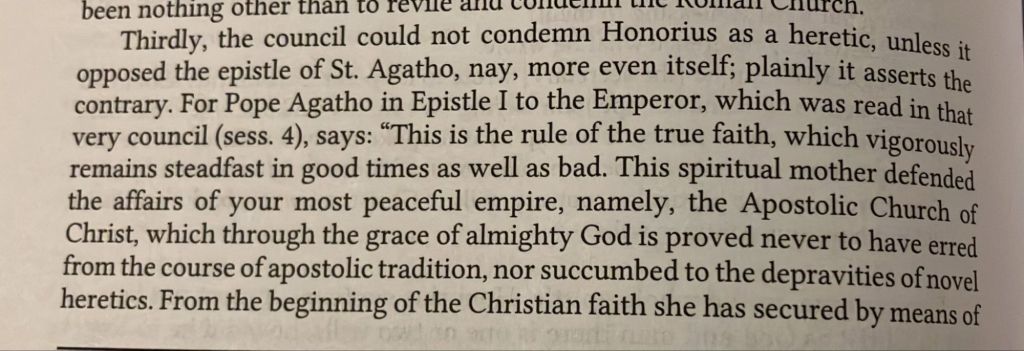
Excerpt from Bellarmine’s On the Roman Pontiff (Grant)
No reply.
Let’s dissect this question further by looking at the sources. In favor of Mr. Ybarra’s argument, the Catholic Encyclopedia has this to say,
“Pope Honorius was subsequently included in the lists of heretics anathematized by the Trullan Synod, and by the seventh and eighth ecumenical councils without special remark; also in the oath taken by every new pope from the eighth century to the eleventh in the following words: “Together with Honorius, who added fuel to their wicked assertions” (Liber diurnus, ii, 9). It is clear that no Catholic has the right to defend Pope Honorius. He was a heretic, not in intention, but in fact; and he is to be considered to have been condemned in the sense in which Origen and Theodore of Mopsuestia, who died in Catholic communion, never having resisted the Church, have been condemned. But he was not condemned as a Monothelite, nor was Sergius. And it would be harsh to regard him as a “private heretic”, for he admittedly had excellent intentions.”
And according to Schaff’s Ecumenical Councils:
In the xvith Session the bishops exclaimed “Anathema to the heretic Sergius, to the heretic Cyrus, to the heretic Honorius, etc.”
I take exception to the idea that Pope Honorius was a “heretic… in fact”. That is to say, materially rather than formally. The oath referenced states that Pope Honorius “added fuel to their wicked assertions” but absent is the word “heretic”. The exclamation of the bishops at the Council also does not hold weight as to the nature of the condemnation, as Warren Carrol notes in The Building of Christendom, “the declarations of a Council do not take effect unless they are ratified by the reigning Pope.” And because charges of heresy are not what Pope Leo II ratified, Honorius cannot be said to be a heretic.
Returning to the article in the Catholic Encyclopedia we will see defenses for Pope Honorius’ orthodoxy laid out by Pope John IV and Maximus the Confessor in these words:
To his elder son John IV addressed a letter known as the “Apology for Pope Honorius”. He explains quite truly that both Sergius and Honorius asserted one Will only because they would not admit contrary wills; yet he shows by his argument that they were wrong in using so misleading an expression. St. Maximus of Constantinople, a monk and formerly secretary of Heraclius, now becomes the protagonist of orthodoxy and of submission to Rome. His defence of Honorius is based upon the statements of a certain abbot, John Symponus, the composer of the letter of Honorius, to the effect that the pope only meant to deny that Christ had not two contrary human wills, such as are found in our fallen nature. It is true that the words of Honorius are inconclusively though not necessarily, heretical.
To put this more simply, the Monophysite heresy is that Christ only has only one will, rather than a human and a divine will. But what Pope Honorius was saying in his reply to Sergius, was that Christ did not possess the concupiscence present in our human will, not, indeed, denying that He had a human will, as Maximus writes in his letter to Marius restated in the Catholic Encyclopedia article on St Maximus the Confessor below:
He declares that Honorius, when he confessed one will of our Lord, only meant to deny that Christ had a will of the flesh, of concupiscence, since he was conceived and born without stain of sin. Maximus appeals to the witness of Abbot John Symponus, who wrote the letter for Honorius.
Obviously this does not mean he is not guilty of precisely what Pope Leo II expressed in the final anathema, i.e.
“Also Honorius who visited this apostolic seat not by the teaching of apostolic tradition, but by profane treachery tried to subvert the immaculate faith, and all who died in their error”
I conclude that the charge of heresy was never in fact confirmed on Honorius, but affirm that he was condemned for the reasons given by Pope Leo II alone.
 I Answer That
Leave a comment